Skip to content

fde

The FDE Fork: Platform or Outcomes

In If LEGO Had Forward Deployed Engineers, I ended with a wrinkle I promised to write up properly: AI keeps handing FDEs new bricks, the line between "forward deployed engineer" and "software engineer" is blurring, and at some point you have to ask whether you even need to productise the dragon at all.

This is that piece. It's now a real choice. There are two coherent ways to run a forward deployed company, AI made the second one viable, and a founder who hasn't consciously picked one is going to build a confused org with a confused FDE role. The nature of the FDE role isn't a fixed thing you can look up. It's downstream of a strategic decision most founders don't realise they're making.

Engineers building messy tools, a polished platform emerging behind them

Foundry was an accident

Start with where the role comes from, because the origin explains everything that follows.

Nobody at Palantir sat in a room and decided to build Foundry. Here's how I described it on a call last year:

The way Foundry as a product actually happened is very interesting. No one said, "Oh, let's build Foundry." It was literally forward deployed engineers working with customers, almost a consulting shop. And the difference between an FDE and a consultant is the alignment: we get paid to solve problems, not to spend hours solving them. Given they were engineers, what they would do is build tools to bootstrap themselves — mainly for the data integration piece. And some customers noticed this and said, "If you just license the tools, we'll pay licence fees for them." That's how Foundry happened. A couple of FDEs went away and said, "We're going to take a few months and build Foundry."

So the product and the FDE motion were entangled from day one. The FDEs weren't there to deliver Foundry. They were there to solve customer problems, and Foundry fell out of the residue — the tools they kept rebuilding to make themselves faster.

That's worth holding onto, because it means the FDE role was never defined by the platform. The platform was defined by the FDEs.

The 2015–2020 thesis: forward deployment in service of a platform

For most of the decade that followed, though, the relationship ran the other way. Once Foundry existed, the FDE motion had a job: feed the platform.

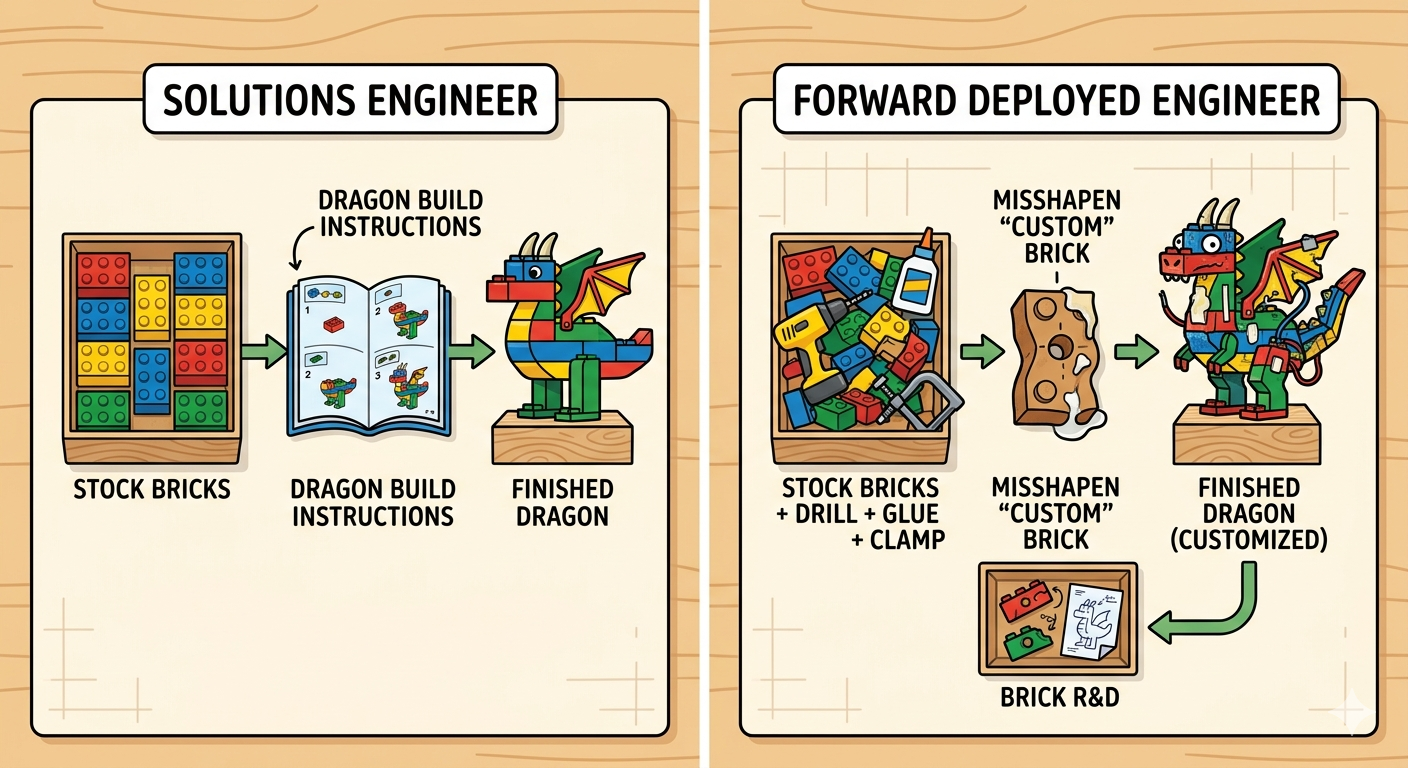
This is the role I described with the LEGO dragon. The customer wants a dragon, there's no brick for the curve of its neck, so the FDE drills holes and glues bricks and builds a Frankenstein scaffold and then builds the dragon. The deliverable to the customer is the dragon. The deliverable to your own company is the bag of weird bricks — the custom hacks you walk back to the product team so they can decide what to manufacture. That loop, customer problem → bespoke build → product signal → real product, was the whole game. The FDE was a product R&D function dressed up as a delivery function.

And the thing that made that motion sustainable — that justified years of low-margin, labour-heavy services work — was the ambition behind it. Palantir wasn't running a consultancy that happened to write software. It was building the operating system for the world's largest and most important institutions, and the services were the cost of discovering the shape of that operating system. You can't find the shape of a platform from a conference room. You find it by embedding engineers in twenty messy customers and seeing which weird bricks keep showing up.

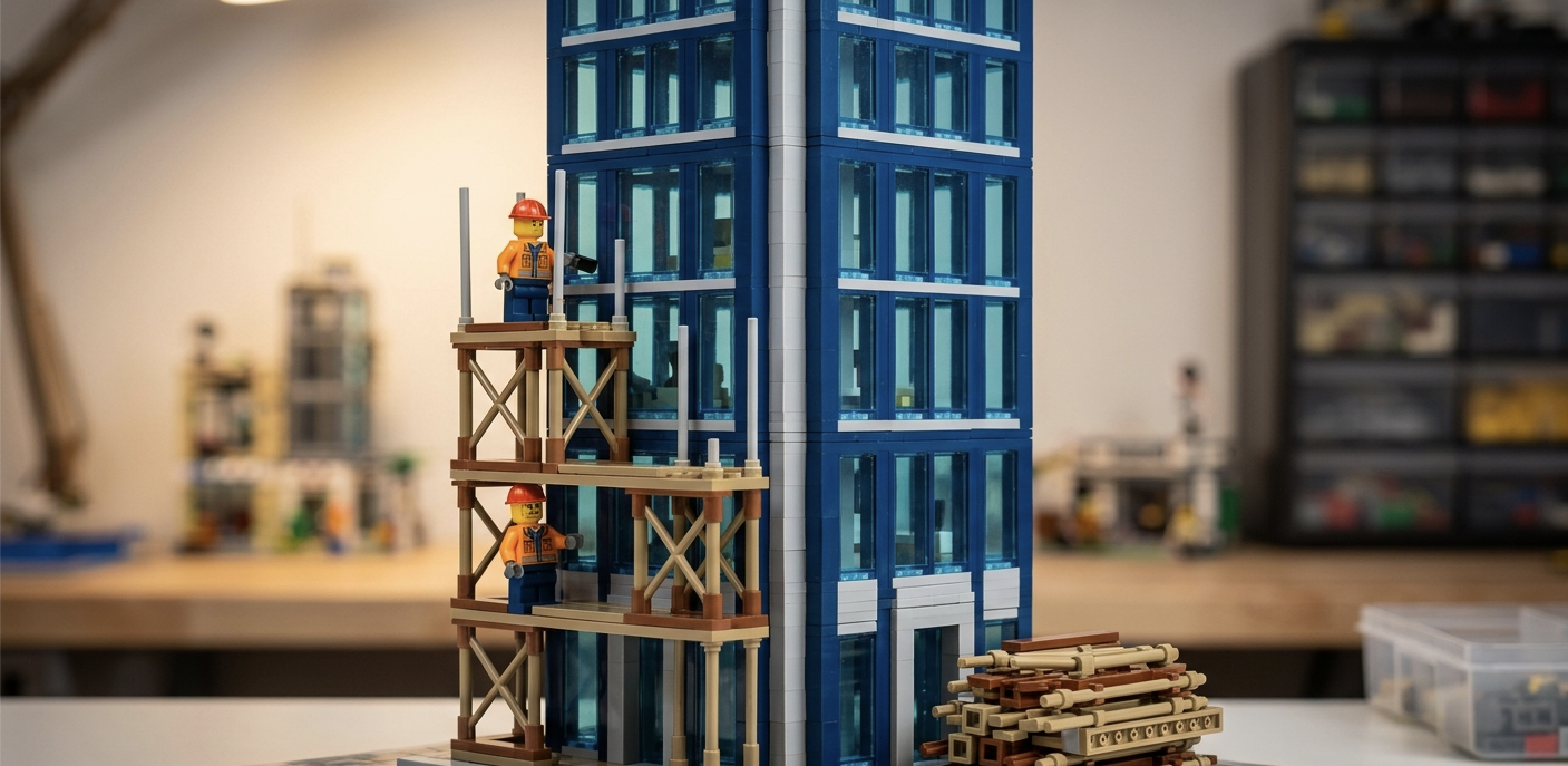
You can see the platform doing its job in the staffing numbers. Early on, a single use case took something like three to five FDEs. By a few years in, the ratio had inverted — one FDE could carry two or three customers, because the platform had absorbed enough of the weird bricks that each new deployment needed less hand-building. The role was, by design, bending towards its own obsolescence. Every brick you productised was a brick the next FDE didn't have to drill.

That's the tell. In the platform model, a healthy FDE org is one that slowly needs fewer FDEs per dollar. The role is a scaffold. The building is the product.
A LEGO tower with its scaffolding being removed

What AI changes

Now the wrinkle.

The reason the platform model made sense wasn't just ambition, it was economics. Services scale linearly with headcount and carry consultancy margins. The only way to escape that gravity was to productise — to convert hand-built dragons into licensable bricks so that, eventually, the customer's own engineers build dragons on top of your platform while you collect licence fees. Productisation was the only exit from the margin trap.

AI weakens that constraint. When a single engineer with Claude Code, Skills, MCP servers, and a stack of internal agents can build a credible dragon in an afternoon, the cost of bespoke delivery collapses. And once bespoke delivery is cheap enough, you can run a services business at margins that used to require a product.

One engineer building a dragon, helped by automated brick machines

This is the "AI-powered services" thesis that Sequoia and YC have been talking about — services companies with software economics. The mechanism is exactly the brick library getting powerful enough that you no longer need to manufacture and sell bricks to make the unit economics work. You just keep the brick-shaping machine internal, point your FDEs at it, and sell the dragons.

So a third model becomes available — and notice it's not new, it's the original model with the economics fixed. Palantir started as "essentially a consulting shop." The reason it couldn't stay one was margins. AI is, in effect, an offer to remove that reason.

The fork

Which gives founders a genuine fork. Two coherent strategies, and you have to pick.

A LEGO road forking towards a platform on one side and a delivery workshop on the other

Path A — Platform. You productise. The FDE is a product scout. The compounding asset is the product, and you sell licences. The bet is that the weird bricks generalise — that the abstraction you extract from twenty customers is good enough that the twenty-first buys the platform instead of the service. You also have to be able to survive the valley: the years of unprofitable services before the licence revenue compounds. This is the Palantir-to-Foundry path, and it works when the abstraction is real and the market is large enough to be worth the wait.

Path B — Outcomes. You don't productise — or rather, you productise internally and only internally. You build the brick-shaping machine, the agents, the deployment tooling, and you never sell any of it. The FDE is a delivery superpower wielding private tooling no competitor can buy. The compounding asset is that internal toolchain plus the accumulated muscle memory of having deployed into a hundred messy environments. You sell outcomes, priced as outcomes. The bet is that AI keeps your margins healthy enough that you never need the licence-fee exit at all.

The honest tension between them is the one I raised in the LEGO piece. I argued there that walking the weird bricks back to product is "the step that makes it engineering" — skip it and you're just a very expensive consultancy in a t-shirt. Path B looks, from the Path A vantage point, exactly like collapsing that tension and building Accenture.

But I don't think that's quite right anymore. On Path B you still walk the weird bricks back — you just walk them back to your own internal platform team instead of to a product you'll sell. The loop still runs. It's just that the flywheel is your internal capability, and it compounds without ever being packaged, priced, documented, or supported for an external buyer. Whether that's a worse flywheel or a better one is genuinely open. It's worse because you forgo license-fee leverage and the discipline that selling a product imposes. It's better because you skip the brutal productisation tax — the years spent making a thing general, supportable, and sellable — and you keep your best tricks proprietary.

That's the fork, two different theories of where the compounding asset lives: in a product you sell, or in a capability you hoard.

What the fork does to the FDE role

Here's why this matters for the role specifically, and not just the cap table.

On Path A, the FDE is a product scout, and that has hard consequences. The incentives have to live at the company level — revenue per forward-deployed person across the whole company, never revenue per engagement. Measure engagements and your FDEs quietly become account managers: they optimise for charging more for each dragon and stop bringing back the bricks. And the role bends towards obsolescence, on purpose. The honest thing I'll say here: I left Palantir partly because I couldn't find an FDE role I'd still enjoy. The platform had matured enough that the discovery work — the actual reason I liked the job — had thinned out. That's not a failure of the model. That's the model working. On Path A, the role is supposed to eat itself.

On Path B, the opposite. There's a line I keep coming back to: when you don't have a product, the FDE is the product. On Path A that's a phase — true in the early days, less true every year. On Path B it's the steady state. The FDE never becomes a scaffold for something else, because there is nothing else; the forward deployed engineer, augmented by internal tooling, is the entire company. The role doesn't sunset. The risk is different and real: without the discipline of an external product to feed, FDEs can drift into pure delivery, and "we shape bricks internally" decays into "we don't shape bricks, we just bill." Path B without a strong internal platform culture really does become Accenture-with-better-margins.

This, by the way, is why "FDE" has become such a confused title. It's become a big fat umbrella — solutions engineer, solutions architect, the Palantir thing, all crammed under one acronym — and people complain it means different things to different people. It does. But a lot of that confusion isn't sloppy language. It's that the companies using the title haven't decided which fork they're on. A Path A FDE and a Path B FDE genuinely are different jobs, with different incentives, different career arcs, and different definitions of success. Of course the word means different things. The companies do.

The choice founders have to make

So the instruction is simple, even if the decision is hard: pick.

The Palantir FDE motion was sustainable because the ambition carried it — the operating system for the world's largest institutions was a vision big enough to justify a decade of unprofitable services. If you're running Path B, you can't borrow that vision, because you're explicitly choosing not to build the sellable operating system. You need your own sustaining story and your own scoreboard: outcomes delivered, margin per FDE, the rate at which your internal tooling makes the next deployment cheaper. Those are different KPIs than "licence revenue" and they reward different behaviour.

What you cannot do is stay ambiguous. An org that hires Path A product scouts, measures them on Path B engagement outcomes, and tells investors a platform story while running a services business will tear its FDE role apart. The FDEs will feel the contradiction first — they always do — and the best ones will leave, because the role they were sold isn't the role the incentives are paying for.

The FDE role was never one fixed thing. It's a function of strategy. In 2015 the strategy was "find the shape of the platform," and the role was a product scout. The strategy could now just as legitimately be "sell outcomes forever, keep the machine internal," and then the role is a permanent, AI-amplified delivery superpower. Both are real companies. Both can be great companies.

AI is what made the second one viable. It didn't make the choice for you. Pick on purpose.
If LEGO Had Forward Deployed Engineers

Forward Deployed Engineer is having a moment. Anthropic and OpenAI are pouring billions into the model. Lots of articles getting written about it. Founders are spinning up "FDE" titles before they've really worked out what the role does. And in nearly every conversation I have — with founders, recruiters, or curious engineers — the same question comes up: what actually makes an FDE different from a really good consultant?

Here's my attempt at explaining the role with a thought experiment.

Messy Lego

The customer wants a dragon

Imagine LEGO decides to spin up a Forward Deployed Engineering org tomorrow. The first customer walks in and says: I want a dragon.

You can solve that request two ways.

The solutions engineer path. A solutions engineer at LEGO has a beautifully organised inventory of every brick the company makes. They read the dragon brief, pick the right 287 pieces, write a clean instruction booklet, maybe even build the model themselves, and hand it over. The customer looks at it and goes, "Hmm — kind of looks like a parrot, but yeah, I can see the dragon. Thanks." Successful delivery. On to the next request.

The forward deployed engineer path. An FDE starts the same way, picking through the existing brick library — but they get stuck. There's no brick that gives them the right curve for the dragon's neck. The wing pieces don't articulate the way they need to. So they grab a brick, drill a hole through it, glue two together, sand a third one flat. They build a Frankenstein scaffolding of custom-modified pieces, and then they build the dragon.

Solutions Engineer vs FDE

The customer looks at the FDE's dragon and says, "Actually, I wanted a Lord of the Rings dragon, not a Zog from Julia Donaldson." Fine. The FDE iterates. More custom hacks. Eventually they hand over a dragon the customer actually loves.

The end state for the two paths look identical — both delivered a dragon. But the FDE has one more step, and that step is the entire point of the role.

The step that makes it engineering

The FDE walks back to the LEGO brick R&D team holding a bag of weird, hacked-together bricks and says: "These are the pieces I had to invent to build that dragon. We don't make any of them. Should we?"

The product team looks at those custom bricks and decides what to do. Maybe they manufacture one of them as a new SKU. Maybe they don't manufacture any specific brick, but the patterns suggest they should build a machine that lets customers shape their own bricks. Maybe they conclude the dragon use case itself isn't worth investing in, but the technique unlocked something else entirely.

That loop — customer problem → bespoke build → product signal → real product — is the whole game. Without it, you are simply a very expensive consultancy in a t-shirt.

This is where the "E" in FDE earns its keep. A forward deployed engineer has to be technical enough to actually drill the hole, glue the bricks, build the thing. Otherwise the signal that comes back is mush. "The customer wanted a dragon and we couldn't build one" is useless. "The customer wanted a dragon, and the only way I could approximate it was by violating the structural integrity of these four standard bricks in this very specific way" is a product roadmap.

Weird Brick

Misaligned incentives, by design

The dirty secret of running a healthy FDE org is that the incentives between FDEs and product teams are deliberately misaligned.

The FDE wakes up every morning thinking: how do I win this customer? What do I have to violate, hack, or hand-build to ship the dragon they want? The product team wakes up every morning thinking: what's the general abstraction that lets us serve a thousand customers without hand-building anything?

Those two incentives pull against each other constantly, and the tension is genuinely uncomfortable. It's also where good product comes from. Collapse the tension by making everyone think like a product manager, and you stop getting customer signal. Collapse it the other way, by making everyone think like a delivery engineer, and you build Accenture. The job of leadership is to hold the rope taut.

One important corollary: FDE KPIs have to live at the company level, not the engagement level. The moment you start measuring revenue per engagement, your FDEs stop being product scouts and start being account managers. They optimise for charging more for the dragon. They stop bringing back the weird bricks. The healthier metric is something like revenue per forward-deployed person, company-wide — because the win isn't the FDE working harder on each engagement, it's the FDE identifying which bricks are worth productising, so that eventually customers' own engineers end up building dragons on top of those bricks while you collect licence fees. That's the flywheel. Engagement-level metrics short-circuit it.

So what is an FDE?

If you take only one thing away: a Forward Deployed Engineer is a product R&D function dressed up as a delivery function. The deliverable to the customer is a dragon. The deliverable to your own company is the bag of weird bricks you had to invent to build it.

If no one is walking back to product with that bag of bricks, you don't have an FDE org. You have a really good services team. Both are valuable, both can be lucrative — but they're different jobs, and conflating them is how organisations end up confused about why their "FDEs" don't seem to be moving the product forward.

There's a wrinkle worth flagging, which I'll write up properly another time: AI keeps handing you new bricks. Claude Code, Skills, MCP servers, agent frameworks — the brick library itself is now powerful enough that a single engineer can build a credible dragon in an afternoon. As the bricks get more capable, the line between "forward deployed engineer" and "software engineer" starts to blur, and you have to ask whether you even need to productise the dragon at all, or whether the right move is to just keep delivering bespoke ones forever. That's a whole other topic.

For now, the LEGO test is enough: drill the brick, build the dragon, bring back the brick. That's the job.

What Claude Code's Creator Validated About Forward Deployed Engineering

Last week, Boris Cherny appeared on Lenny's Podcast to talk about Claude Code — the AI coding assistant that now generates 4% of all GitHub commits and helped Anthropic achieve a 200% productivity increase.

Every major insight Boris described — from building for future capability rather than current constraints to finding product-market fit through "latent demand" — perfectly captured what we'd been doing as Forward Deployed Engineers at Palantir for over a decade. It was like listening to someone independently discover gravity.

For seven years at Palantir, I lived the FDE model: small, elite teams embedded directly with customers, building systems ahead of their current capability, discovering requirements by watching how people actually worked rather than what they said they needed. Boris validated that this approach isn't legacy — it's the future of how we'll build AI products.

Building Six Months Ahead

"Build for the model 6 months from now, not today," Boris said. The Claude Code team deliberately avoided over-scaffolding. They gave the model tools and goals and got out of the way, betting on rapid capability improvements rather than constraining the system to current limitations.

This hit me because it's exactly how FDEs approach customer deployments. We don't build systems for where an organization is today — we build for where they'll be in six months. When I was deploying Palantir at large enterprises, the worst mistake was to over-constrain the system to current workflows. The org would evolve, their data would grow, their processes would mature, and suddenly the system we'd carefully tailored to their "requirements" became a straightjacket.

The best FDE deployments gave customers slightly more capability than they could immediately use. We'd build data pipelines that could handle 10x their current volume. We'd create analysis workflows that assumed they'd eventually want to ask more sophisticated questions. We'd design user interfaces that didn't require retraining when their team grew from 5 to 50 people.

This wasn't over-engineering — it was under-constraining. Just like Claude Code bet on the model getting smarter, we bet on the customer getting more sophisticated.

Latent Demand as Product Compass

One of Boris's revelations was that Claude Code's breakthroughs came from watching how people used it in creative ways. Data scientists running SQL queries in terminal windows. Non-technical users asking it to help grow tomatoes. People recovering corrupted wedding photos. This "latent demand" led to Cowork, built in just 10 days because they could see exactly what users were trying to do.

"Latent demand" is just Boris's term for what FDEs do every single day: sit with users and watch how they actually work.

The best features I ever built came from observing workarounds. An analyst who'd manually copy-paste data between systems every morning because the official integration was too rigid. An operations team that kept a separate spreadsheet to track what the official dashboard couldn't show them. An investigator who'd screenshot charts to paste into Word documents because the export function didn't capture what they needed to communicate.

These weren't feature requests — they were organizational antibodies. Users working around the system to get their real job done. Standard product management would survey these users and ask what features they wanted. They'd probably say "better export" or "more integration options." But that's not what they actually needed.

FDEs watch the workflow, not the words. We see the person taking screenshots and realize they don't need better export — they need a way to tell stories with data. We see the manual copy-pasting and realize the issue isn't integration — it's that the official process doesn't match how the work actually flows.

The most successful FDE engagements came from finding latent demand the customer couldn't articulate themselves. Not because they were dumb, but because they were so close to their daily work they couldn't see the pattern.

Ideas Over Engineering Capacity

"Coding is largely solved," Boris said. "The bottleneck is ideas and prioritisation." In the AI era, the new scarcity isn't engineering capacity — it's knowing what to build.

This validates everything FDEs were designed to solve. We were never primarily about coding. Yes, we could write software — often quite quickly — but our real value was understanding the problem deeply enough to know what to build.

The best FDE I worked with at Palantir wasn't the best coder on the team. They were the person who could sit in a room with a counter-terrorism unit and figure out what actually mattered. Who could distinguish between what the organization said it needed and what would actually make their mission successful. Who could see patterns across different deployments and recognize when a specific customer's problem was actually a general case of something we'd solved before.

This person would often write less code than junior engineers on the team. But they'd save months of work by solving the right problem the first time.

Now that AI can generate most code, this skill becomes even more critical. If Claude can write your functions, your value is knowing which functions need to exist.

The Death of "Software Engineer"

"The title 'software engineer' is dying," Boris observed. "Builder is the new reality." As AI democratizes coding, roles blur between engineering, product, design, and deployment.

FDEs were always "builders." Our job description was impossible to write because we did everything: product research, technical architecture, user interface design, data engineering, deployment operations, user training, and ongoing support. We didn't fit neatly into any org chart because the role was defined by outcome, not function.

Traditional software engineering was about implementing specifications. Someone else figured out what to build; engineers built it. But FDE work was always end-to-end ownership. We figured out what to build, built it, deployed it, and lived with the consequences.

This frustrated a lot of people who wanted clean role boundaries. But it was extraordinarily effective for solving complex, novel problems where the solution space wasn't well-defined.

The industry is catching up to what Palantir figured out years ago: when you're building something truly new, you need people who can think across the entire stack — technical, product, and operational. "Builder" is a better word than "engineer" because it captures the full scope.

What This Means for AI Companies

If you're building AI products today, the FDE model isn't legacy — it's your playbook.

Stop organizing around functional silos. Find people who can think across the whole problem, give them access to the best tools, and embed them directly with customers. Build slightly ahead of current capability rather than constraining to current workflows. Watch how people actually use your product, especially the ways they "misuse" it.

Most importantly: understand that your bottleneck isn't engineering capacity anymore. It's product judgment. It's knowing what to build. It's finding the latent demand that customers can't articulate themselves.

The companies that figure this out first will eat everyone else's lunch. Not because they have better AI models, but because they'll build the right things.

Boris Cherny just validated fifteen years of FDE practice. The future belongs to builders who can think end-to-end, work embedded with customers, and see patterns others miss.

The tooling has changed. The principles haven't.

The FDE Manifesto: What Would Stokes Do?

This is a version of a document I had written during my time at Palantir.

Stokes was a legendary FDE at Palantir, and I learnt a lot by emulating his way of operating. This wasn't hero worship—it was shorthand for a specific way of operating that separated exceptional FDEs from the rest.

Here are the tactical principles that define that approach.

Never Take Shortcuts That Compound

  • Don't make config changes that aren't product defaults
  • Never restart services "just to see if it fixes things"—you're destroying evidence
  • Never deploy dirty builds. If you're on a branch, getting back to mainline is P0
  • Every custom modification is technical debt with compound interest

Own the Product Stack

  • Clone the repos. Make them build. Start submitting PRs
  • When you get a stacktrace, read it. Form a hypothesis before opening tickets
  • Know the architecture cold—when telemetry fails, it's your only map
  • If a workflow is blocked on a feature, scope it and build it yourself

Treat Information as Infrastructure

  • Ensure logs and metrics are collected properly from day one
  • Master telemetry tools—they're not optional
  • Read everything: docs, runbooks, release notes, support tickets, Stack Overflow
  • Monitor what other teams are encountering—their problems will be yours soon

Root Cause Everything

  • Never accept "it's working now" as resolution
  • Gather data and form hypotheses before implementing fixes
  • You must be able to explain why the product broke and why your fix worked
  • Document your debugging process for future you

Build Strategic Relationships

  • Every support ticket is a relationship-building opportunity with core engineers
  • Contribute field signal to product direction—you're their eyes and ears
  • Know the product team's roadmap and weigh in based on deployment reality
  • Getting your tickets prioritized is a function of relationships, not just severity

The Strategic Thread

These aren't random best practices. They're behaviours that compound into a strategic advantage: radical ownership of outcomes.

When you refuse shortcuts, you're choosing long-term system health over short-term wins. When you master the product stack, you're becoming a peer to the product team, not a consumer. When you root cause everything, you're building institutional knowledge that makes future problems trivial.

This is what makes the FDE model powerful. You're not there to implement solutions—you're there to own outcomes completely. That ownership manifests in these specific, tactical behaviors that seem small but fundamentally change how you operate.

The question isn't whether you can do these things. It's whether you will.


Building an FDE organization? These principles are your hiring rubric. Look for engineers who already think this way.

These principles form the evaluation criteria in my FDE Interview Scorecard.


Implementing an FDE hiring program? See my FDE Advisory Materials for interview templates, scorecards, and detailed process guides.

Forward Deployed Engineers and how to hire them

Hiring multi-faceted people who can straddle the boundaries of technical and business problems can be a huge asset for organizations. I met and worked with many such people during my time at Palantir. I also hired a lot of them. This post is about learnings from my time at Palantir as a Hiring Manager for FDEs.

What is an FDE?

A Forward Deployed Engineer is a unique role that Palantir has. The linked blog post is a great intro to the role and what a day in the life of an FDE looks like, but I want to share my perspective and my experience as an FDE, and an FDE hiring manager.

FDEs are generalist problem solvers with technical skills, with a focus on solving important problems. They are able to identify high value problem solving that will have immense business impact -- this requires strong business intuition as well as high user empathy. They are also unfazed by chaos and complexity. In fact, they thrive in environments where there is a lot of uncertainty.

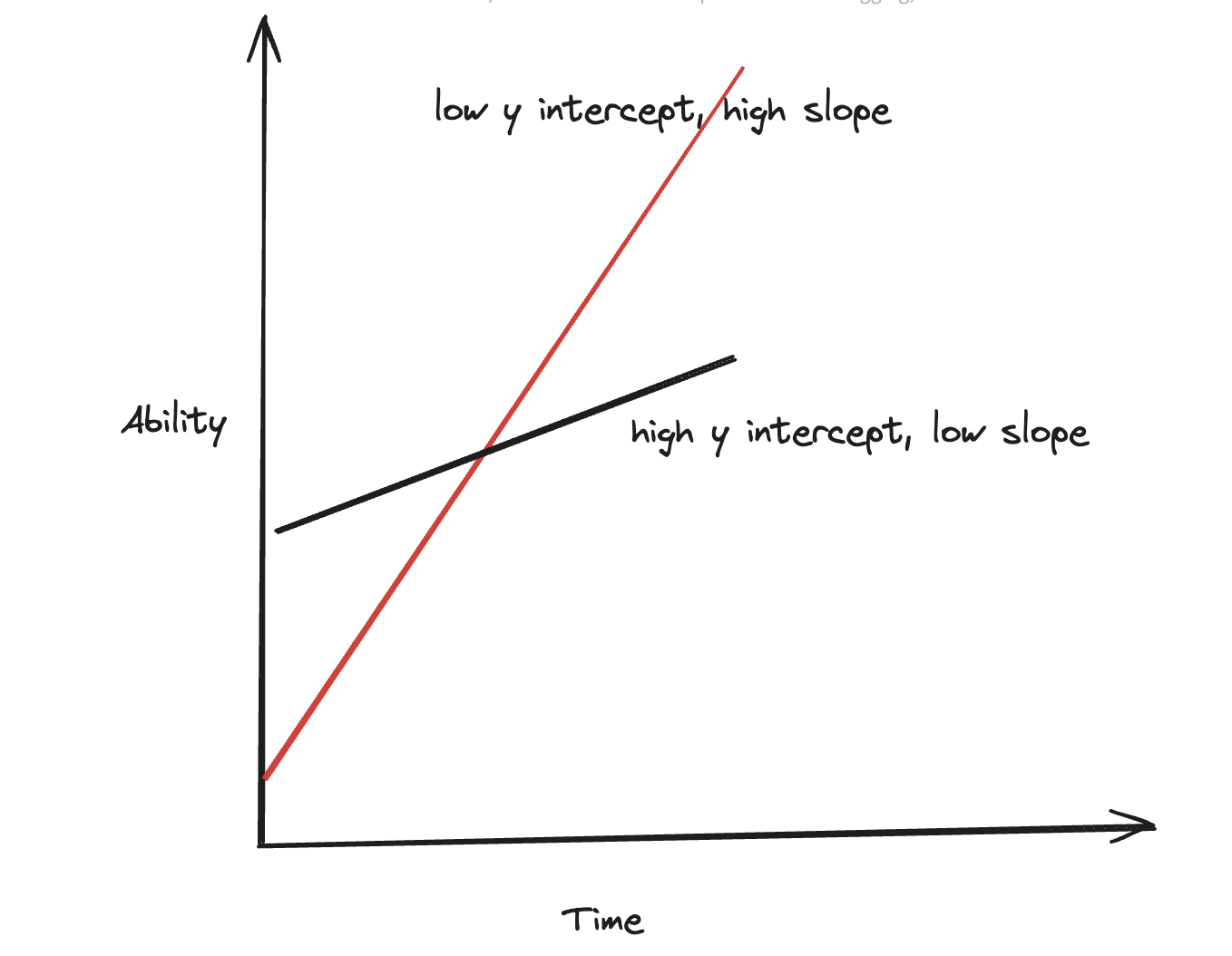
As you can imagine FDEs are notoriously hard to hire. As an interviewer, you are looking for someone who is not set in their ways, but has a high ability to learn and grow. This individual may not necessarily be super experienced -- in fact, in a lot of cases, they will be just starting.

high slope

How to hire them?

I usually think about hiring in terms of Essentials and Unforgivables - qualities that the candidate must have and absolutely should not have.

Essentials:

  • Outcome Oriented: Always keep the goal in mind, always seek to solve problems.
  • Critical Thinker: Not afraid to question authority, and someone who can judge ideas on their own merits.
  • High Chaos Ceiling: Doesn't struggle with ambiguity and chaos.
  • Gritty: This isn't necessarily synonymous with hard worker, though there is a high correlation. Someone who isn't afraid to scale the mountain.

Unforgivables:

  • Goes after the shiny thing: This is the opposite of outcome oriented. Someone who doesn't tie their work to impact.
  • Passive: They tend to wait to be told what to do, and not seek out opportunities to solve problems.
  • Entitled: High maintenance and high ego.

I have found that trying to understand where a candidate stands with these qualities is a good way to get a sense of whether or not they will be successful.

Some questions I ask to suss this out:

  • How did you get from A→B→C and why? How was A→ B different than B→C , what would have happened if you went straight from A→ C?
  • What is the hardest thing you have done/worked on/learned so far? Why was this hard for you?
  • What was the hardest failure you have dealt with? Did you see it coming? How did you salvage the situation? Who did you ask for help?
  • Tell me about a time when you proactively did something outside your day to day responsibility.

But at the end of the day it's about getting to know the person. Understanding what makes them tick, what keeps them going, and why.

The Impact of FDEs

FDEs can be a highly impactful addition to your organization when hired correctly. Their ability to bridge technical solutions with real-world business challenges makes them invaluable in today's complex tech landscape.

FDEs have been a cornerstone of Palantir's success, acting as their "secret sauce" in delivering transformative solutions to their clients. Their versatility, coupled with their technical prowess and business acumen, allows them to drive significant value across various industries and problem domains.

However, identifying and hiring the right FDEs can be a challenging process. It requires a nuanced understanding of the role and a strategic approach to assessing candidates.

Get in touch!

If you're intrigued by the potential of FDEs but find yourself struggling with the hiring process, I'm here to help. Whether you need advice on interview techniques, assistance in defining the role for your organization, or strategies for assessing candidates, feel free to reach out.

Contact me at me@anjor.xyz to discuss how we can improve your hiring process and build a team of high-impact problem solvers. Let's work together to bring the transformative power of FDEs to your organization.


Implementing an FDE hiring program? See my FDE Advisory Materials for interview templates, scorecards, and detailed process guides.