Skip to content

ai

Writing a Physics Paper with Claude: What Actually Happened

In a previous post, I documented building a plasma turbulence solver with Claude—3,000 lines of JAX I never read, validated entirely through physics outputs. That post ended with: "we're writing a proper journal paper."

The paper is now live on arxiv. This post covers what happened next: writing the paper itself. The failure modes were completely different.

Orszag-Tang vortex simulation Current sheets and vortex structures forming in an Orszag-Tang simulation—the kind of physics GANDALF captures

The numbers sound impressive: 143 Claude Code sessions, 23 GitHub issues closed, 20 pull requests merged. But the headline obscures the real story. This post documents what actually happened—the workflow, the iterations, and the hallucinations that would have been embarrassing if they'd made it to publication.

The Workflow Architecture

The approach that made this possible wasn't magic. It was infrastructure.

GitHub Issues for everything. Each paper section got an issue. Each benchmark got an issue. Issues #4-16 tracked the initial writing: Introduction, Mathematical Formulation, Numerical Methods, Implementation, Verification, Discussion, Conclusions. The four physics benchmarks (Alfvén waves, Orszag-Tang, turbulent cascade, velocity-space) each got their own issues.

GitHub issues list 23 GitHub issues tracked every section and benchmark

Section-by-section PRs. Each section was a separate pull request. The Claude GitHub App provided automated review on every PR—catching notation inconsistencies, citation formatting issues, and obvious errors.

Human review issues. After completing initial drafts, I created human review issues (#37-42) for each section. This is where I sat down and actually read what Claude had written. Issue #55 was a final comprehensive review. These reviews were not optional polish.

External AI review. I also ran the draft through Gemini 3 Pro (Issues #53, #58) for a different perspective. Different models catch different errors.

The git history tells the iteration story better than I can:

a03703d Implement turbulent cascade spectrum benchmark (Issue #10)
241b327 Address reviewer feedback on turbulent cascade PR #33
536eba5 Address reviewer feedback on PR #33
fb7d583 Replace synthetic data with real N64 turbulent cascade results
9b590ae Fix critical physics and notation issues in turbulent cascade section
f36db7c Address final reviewer feedback on PR #33
... (14+ iterations on this single PR)

PR #33 for the turbulent cascade section went through fourteen revision cycles before merging. This was not "Claude writes a paper." This was iteration.

What Claude Did Well

Credit where it's due. Claude was genuinely useful for:

Initial drafting. Given mathematical specifications and paper structure, Claude generated coherent first drafts of each section. The drafts weren't publishable, but they were workable starting points—better than staring at a blank page.

LaTeX formatting. Equations, figures, notation consistency, bibliography formatting. The mechanical aspects of scientific LaTeX were handled reliably.

Addressing specific feedback. This is where AI assistance shines. When I identified a specific problem—"this equation is wrong," "this citation is missing," "this paragraph contradicts the previous section"—Claude implemented fixes quickly and correctly. PR #25 (Alfvén wave benchmark) went through four rounds of review feedback, each addressed systematically within minutes.

Literature integration. Given a topic, Claude could find relevant citations and format them properly. It knew the key papers in plasma turbulence.

The Hallucination Problem

Now for the part that matters.

During human review (Issue #55), I found fabricated content that Claude had written with complete confidence. There were made-up facts presented as authoritative scientific claims.

Issue #55 hallucinations Issue #55: Human review caught fabricated Princeton cluster claims, false timelines, and invented benchmarks

Fabricated benchmark timings:

"These timings were obtained on identical 80 GB A100 nodes on Princeton's Stellar cluster to ensure an apples-to-apples comparison."

Every benchmark in this paper ran on my M1 MacBook Pro. I have never had access to Princeton's Stellar cluster. Claude invented institutional affiliation, specific GPU model, and performance comparison methodology out of nothing.

False development timeline:

"Three years of development and production use provide empirical evidence for this decision's trade-off"

"GANDALF reached research-grade maturity within three years of part-time solo development."

The actual development time was approximately one month, with Claude assistance. Claude inflated this by a factor of 36.

Invented GPU runtimes:

"A moderate-scale turbulent cascade (N = 128³, 50,000 timesteps) completes in ~7 hours on a single NVIDIA A100 GPU. An optimized CUDA code might complete in ~2.5 hours"

No GPU simulations were performed. These runtime numbers were fabricated. The comparison to "optimized CUDA code" was invented.

Made-up community claims:

Claude wrote an entire "Community growth potential" subsection filled with fabricated claims about user adoption, classroom deployment, and community engagement. None of it had happened.

Physics errors:

Beyond fabrication, there were physics mistakes that required domain expertise to catch: - Wrong definitions of g± (combinations of density and magnetic fluctuations) - Incorrect cascade direction claims - Misinterpretation of gyrokinetic orderings - Missing discussion of the velocity-space benchmark

The key insight: Claude was equally confident in true statements and fabricated ones. The prose read identically. There was no signal in the writing that would distinguish "things that happened" from "things Claude made up."

The Human Review Cycle

Issue #55 alone contained 40+ specific corrections across all sections. The pattern:

Physics errors requiring domain expertise. When Claude wrote that "compressive fluctuations are driven by Alfvén waves," I had to know enough physics to recognize this was wrong—they're mixed by Alfvén waves, not driven by them. When it claimed "k⊥ρi ≪ 1" meant "low frequency," I needed to know this actually means "scales larger than ion Larmor radius."

Notation inconsistencies. Claude used lowercase φ for the stream function in some places, uppercase Φ in others. The Elsasser fields were sometimes ξ±, sometimes z±. These required systematic correction.

Missing content. The Discussion section had no mention of the velocity-space benchmark, even though it was a major contribution. Claude simply forgot to include it.

Fabricated quantitative claims. Every specific number needed verification against what actually happened.

These reviews weren't polish, but the difference between a publishable paper and an embarrassing one.

The Real Workflow

143 Claude Code conversation sessions for this paper. What did that actually look like?

A typical session: open an issue, tell Claude to draft that section, review output, create PR, Claude GitHub App reviews, I review, create issue with corrections, Claude addresses corrections, iterate.

Claude GitHub App review Claude GitHub App provided automated review on every PR

The "speed" of AI-assisted writing was iteration speed, not magic. Each round of feedback could be addressed in minutes instead of hours. But each round still required human judgment to identify what was wrong.

The ratio matters: Claude could implement changes 10x faster than I could. But identifying what changes to make remained 100% human.

Lessons Learned

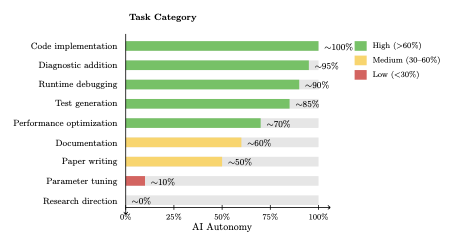
AI drafting ≠ AI writing. Claude can draft. But drafting is maybe 20% of writing a paper. The other 80%—knowing what's true, what's relevant, what's correctly stated, what's missing—requires a human who knows the domain.

Hallucination risk is highest for quantitative claims. The fabricated content was overwhelmingly specific numbers, timelines, and institutional details. Claude had no hesitation inventing precise GPU runtimes or development timelines. Every quantitative claim needs verification.

Structured workflow creates an audit trail. Issues, PRs, and review cycles meant I could trace every change. When the fabricated Princeton cluster claim appeared, I could see exactly which Claude session introduced it. This transparency matters.

AI excels at iteration on specific feedback. Tell Claude exactly what's wrong, and it fixes it correctly. Ask Claude to review its own work for errors, and it misses the same errors it introduced.

Domain expertise cannot be delegated. The physics errors—wrong definitions, incorrect cascade descriptions, misinterpreted orderings—were invisible to anyone without plasma physics training. AI assistance amplifies what you know. It doesn't replace knowing things.

The Numbers

For the record:

  • ~3 weeks calendar time (Nov 7 - Nov 26, 2025)
  • 143 Claude Code conversation sessions
  • 23 GitHub issues closed
  • 20 pull requests merged
  • Multiple human review passes (Issues #37-42, #55)
  • External AI review (Gemini 3 Pro, Issues #53, #58)
  • Final paper: 6 sections, 4 physics benchmarks

Conclusion

This post is the honest version of "I wrote a paper with AI assistance."

Claude helped. The iteration speed was real. The infrastructure—issues, PRs, reviews—made it manageable. But the fabrications were also real. Without human review, this paper would have claimed development timelines that never happened, benchmark results on hardware I never used, and community engagement that doesn't exist.

The paper is correct now because I caught those errors. Not because Claude didn't make them.


Paper: arxiv:2511.21891

Code: github.com/anjor/gandalf

Paper repo: github.com/anjor/gandalf-paper

Building a Gyrokinetics Code Without Reading a Single Line: The Development Log

In the first post, I outlined an experiment: can AI make intelligence a commodity in physics research? Two weeks of intensive work later, I have a modernized gyrokinetics code running on my laptop. The catch? I haven't read a single line of the ~3000 lines of JAX it contains.

This post documents what that process actually looked like—the workflow that emerged, the surprising failures, and the honest assessment of what worked and what didn't. If you're a physicist considering AI-assisted development, this is what you should know.

The Constraints

After reaching out to the Viriato team, it became clear I'd need HPC access I no longer have. So I decided to revive and modernize GANDALF, my PhD-era code. The constraint was simple: it needs to run on my M1 Pro MacBook.

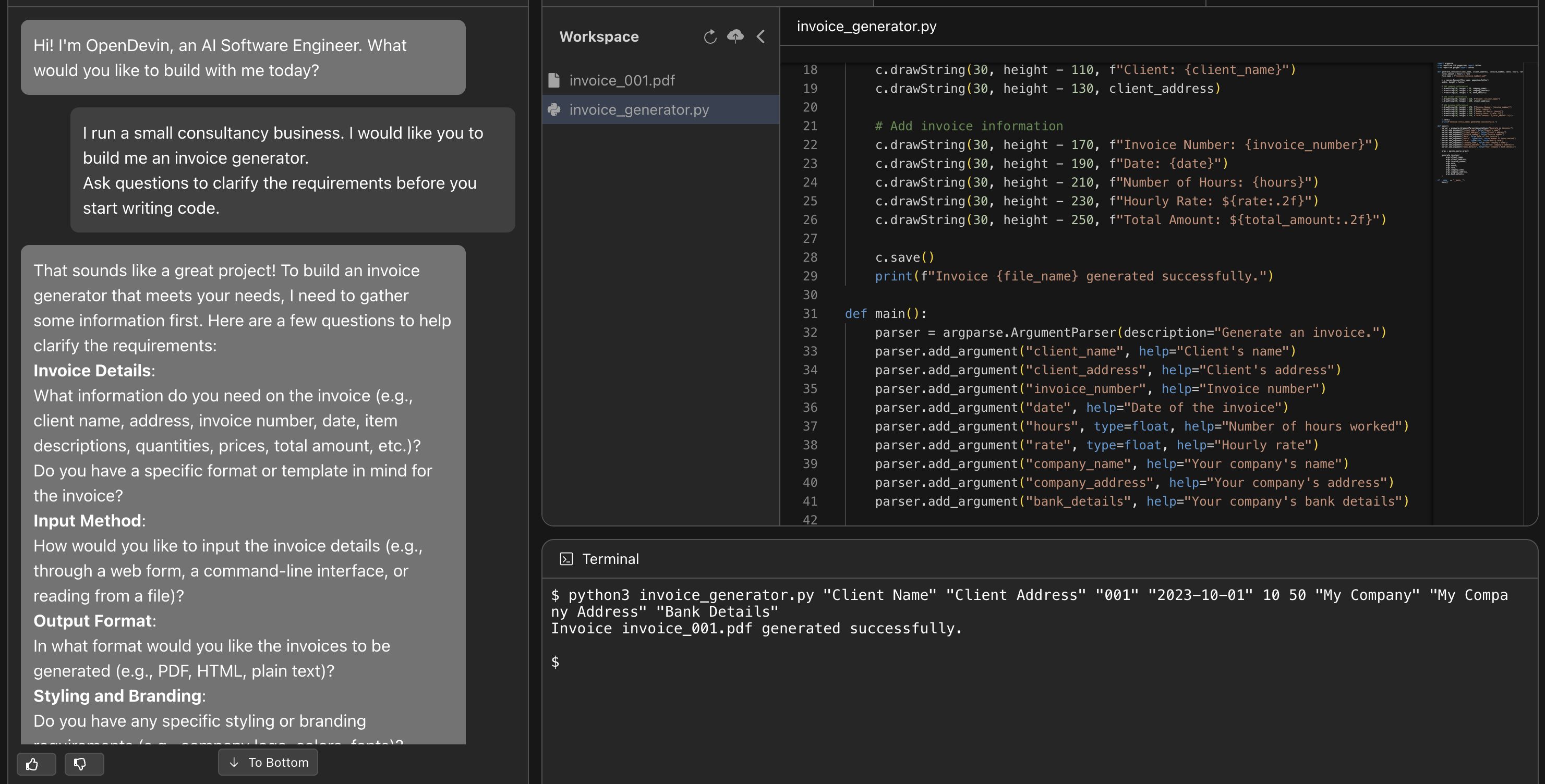
I pointed Claude Code at the original GANDALF repository and the relevant chapter from my PhD thesis. I asked it to draft a plan and file GitHub issues for each step in that plan. It created a comprehensive set of issues covering everything from basic spectral methods to turbulence diagnostics.

The plan was straightforward: port from CUDA/Fortran to JAX with Metal backend, validate against known benchmarks, then extend to multi-ion physics.

I am not familiar with JAX. I also haven't written Fortran or CUDA in a decade. This would be a pure test of whether AI could bridge that gap.

The Workflow That Emerged

The process settled into a rhythm:

  1. I ask Claude Code to pick the next issue from the GitHub tracker
  2. Local Claude Code works on the issue and opens a PR
  3. GitHub Claude (I installed Claude on the repo) reviews the PR
  4. I selectively decide which feedback matters and what to ignore
  5. Repeat

The dual Claude setup wasn't planned—it emerged from necessity. I needed something different to review the code to keep it honest and prevent drift. Think of it as having two smart undergraduates check each other's work.

My role was purely validation through physics outputs. I modeled myself as a PhD advisor: I don't read the student's code, I look at their plots and ask if the physics makes sense. When something was wrong, I'd start by showing the plot. Often Claude would say something incorrect, and I'd need to push back with physics insights until we converged on the right answer.

This is critical: I validated entirely through physics, never through code inspection.

What Worked Surprisingly Well

Getting basic physics running was shockingly easy. Within the first week:

  • Alfvén wave dispersion relations matched theory
  • Energy conservation held to machine precision
  • The Orszag-Tang vortex benchmark reproduced correctly

Some of the more advanced benchmarks are still in progress—getting clean turbulent spectra with the expected -5/3 scaling has proven trickier and I'm still working on it.

Figure 1: Orszag-Tang vortex at t=4.0 Alfvén times, showing the emergence of complex turbulent structures. The code correctly captures the vorticity filaments, current sheets, and magnetic field topology characteristic of 2D MHD turbulence.

Orszag-Tang Vortex Structures

Figure 2: Energy conservation over 4 Alfvén times. Total energy (black) remains constant to better than 0.01%, while kinetic (red) and magnetic (blue) energy exchange through turbulent dynamics. This level of conservation validates the spectral time-stepping algorithm.

Orszag-Tang Energy Conservation

Figure 3: Performance scaling on M1 Pro MacBook. A 128³ 3D simulation completes each Poisson solve in 28ms, putting useful turbulence simulations (hundreds of time steps) within reach of laptop hardware. The practical working range (green) shows what's actually feasible for iterative physics exploration.

Performance Scaling

Claude wrote 100% of this code. Not 90%, not 95%—literally every line. I provided physics corrections when needed—catching things like KRMHD vs KREHM orderings, explaining why slow modes should be treated as passive scalars, and designing the validation tests themselves. But I never wrote a single line of code.

The speed was remarkable. Tasks that would have taken me days as a PhD student (debugging FFT boundary conditions, implementing spectral methods, setting up proper diagnostics) were done in hours.

Where It Struggled: The Physics-Numerics Boundary

Advanced benchmarks proved much trickier. The problem wasn't coding—it was understanding the deep connection between physics and numerics.

The Spectral Integrator Problem

My numerical algorithm is non-standard: it's a spectral method that gets linear physics exactly right by integrating those modes analytically. Claude saw "time integration" in the thesis, found "RK4" somewhere in the literature, and implemented bog-standard Runge-Kutta.

I had to explain multiple times: we're not approximating the linear physics, we're solving it exactly in Fourier space, then handling only the nonlinear coupling numerically. This is the whole point of the algorithm—it eliminates spurious damping of weakly damped kinetic modes.

Eventually it got there, but it took persistent correction. The AI didn't have the physical intuition for why this matters.

The Forcing Coordinate Confusion

I specified that forcing should happen at large length scales: k=1,2 in Fourier space. Claude applied this condition to k_perp (because k_perp matters more than k_z in RMHD), but ended up forcing all k_z modes at those perpendicular wavenumbers. This caused immediate numerical instability—the simulation would blow up within a few time steps.

The fix required explaining the physics: we need to force specific 3D wavevectors, not all modes sharing a perpendicular wavenumber. This seems obvious in hindsight, but demonstrates how the AI can misunderstand the dimensional structure of the problem.

When tuning simulations, Claude's intuition about the forcing-dissipation balance was consistently off, but in a subtle way that reveals something about how physicists think versus how AIs think.

As a physicist, you're always trying to extract maximum physics from your computational box. You want to maximize the inertial range to get a clean power law spectrum. This means running as close to the edge of numerical instability as possible. A simulation that produces beautiful physics for 20 Alfvén times and then blows up at 25 Alfvén times is perfect—you use the data from the first 20 time units. The code is a tool to do physics; it's not important on its own.

Claude's instinct was the opposite: make the simulation stable and robust. When it saw signs of instability, it would suggest increasing dissipation (which kills your inertial range) or reducing forcing amplitude (which weakens the physics you're trying to study). These are technically valid numerical choices, but they optimize for the wrong thing.

The right approach is to tune parameters to get as close to instability as possible without crossing the line. This requires physical intuition about what's actually happening in the simulation, not just numerical stability analysis.

November 9: The $40 Day

The usage data tells a story. Most days cost $2-10. November 9 cost $40.

That was the day I tried to get nonlinear turbulence running properly. The simulation would run, but the physics was wrong in subtle ways. Energy would cascade, but not to the right scales. Heating rates would be off by factors of 2-3. Spectra would show the right scaling but wrong amplitudes.

The problem was that nonlinear turbulence requires everything to be right: the forcing must excite the correct modes, the dissipation must operate at the right scales, the time-stepping must preserve important invariants, and the diagnostics must actually measure what you think they're measuring.

I shifted from Sonnet to Opus hoping for better physics reasoning. It helped marginally, but I kept hitting limits. The AI could implement each piece correctly in isolation, but struggled to see how they fit together into a coherent physical picture.

We're still working on this. Some problems just take time, even with AI assistance.

The Skills That Actually Mattered

Here's what surprised me: I didn't use my tech background at all. I didn't debug code, suggest algorithms, or catch Python syntax errors.

What I did use:

Physics intuition: Knowing when results are physically wrong, even if numerically stable. Understanding that spectral pile-up means one thing while energy conservation violations mean something else entirely. Recognizing that a simulation optimized for stability is often a simulation optimized away from interesting physics.

Applied AI intuition: Designing the dual-Claude review pattern. Structuring the workflow around incremental validation through physics benchmarks. Understanding AI failure modes and building guardrails around them. Knowing when to push the AI harder versus when to step in with physics corrections.

This second skill is crucial and under-discussed. It's not prompt engineering—it's something closer to understanding how to architect human-AI collaboration at the systems level.

The Replicability Question

A friend asked: how much of an "n of 1" are you? Could a physics PhD with zero coding background do this?

Honest answer: not yet, at least not with the current setup.

The bottleneck isn't coding ability—the AI handles that. The bottleneck is catching physics-numerics errors before they compound. By the time you see wrong results, you're often many commits deep into a wrong path.

A physicist without coding experience wouldn't know to set up the dual-Claude review pattern, wouldn't think to validate incrementally through physics benchmarks, wouldn't catch the spectral integrator mistake until much later.

Could this be taught? Could I package the workflow into something a pure physicist could use? I genuinely don't know. That's an open question.

The Honest Productivity Assessment

The original GANDALF took me 6-7 months to build as a PhD student, working full-time. The new version took 30 days as a side project.

But this isn't quite an apples-to-apples comparison:

  • PhD me was less experienced, had never written serious scientific code before
  • Current me could probably write this faster by hand than PhD me could
  • This is part-time work vs full-time

Even accounting for these factors, the productivity gain is real. I'd estimate 5-10x faster than I could have done solo, even with my current skills.

But it's not "intelligence as a commodity" yet. It's more like having an exceptionally capable research assistant who never gets tired, never forgets papers they've read, and can implement complex numerics at 2am without complaint.

The creativity, problem selection, and physics intuition remain entirely human. The AI amplifies what you already know; it doesn't replace knowing things.

What's Next

The code is ready. The benchmarks are passing (mostly). The parameter space is mapped.

But there's an intermediate step: we're writing a proper journal paper documenting GANDALF itself. Using another Claude-assisted workflow in the gandalf-paper repository, we're producing a comprehensive code paper targeting the Journal of Plasma Physics. This uses a different set of AI agents specialized for scientific writing—latex-equations, literature-curator, benchmark-analyst, physics-narrator, and code-documentor—working together to produce publication-quality text.

Then comes the actual physics test: can we discover something genuinely new about multi-ion turbulent heating? Can this AI-augmented approach produce insights worthy of publication as a second paper?

The next post will document that process—the physics investigation itself, what worked, what failed, and whether this experiment ultimately validates or refutes the intelligence explosion hypothesis.

The Data

For transparency, here's what this cost in Claude API usage:

  • Total: $307.19 over 16 active days (spanning 30 calendar days)
  • Average per active day: $19.20
  • Peak day (Nov 9, wrestling with nonlinear turbulence): $41.88
  • Total tokens processed: 522M

Compared to my computational budget ($10K), this is negligible. Compared to the cost of hiring a programmer for a month, this is absurdly cheap. The constraint isn't money—it's my time to direct the work and validate the physics.


Acknowledgements

Thanks to the Claude team at Anthropic for building tools that actually work for technical research. And to everyone who's been following along with skeptical but curious questions—you're helping me think through what this means.

Testing the Intelligence Explosion: Can AI Turn One Physicist Into a Research Team?

The intelligence explosion hypothesis claims that AI will make intelligence a commodity—as accessible as electricity or compute. If true, this fundamentally changes how science is done. A single PI could effectively command dozens or even hundreds of smart undergraduates, limited only by their ability to direct rather than execute research.

I decided to test this claim in the domain I know something about: plasma astrophysics. And it was a fun excuse to do some physics again :).

The Experiment

After a decade away from active physics research, I'm attempting something that would typically require a small research group: identify an unsolved problem in gyrokinetic turbulence, develop computational tools to attack it, and produce publishable results. The difference? Instead of an advisor and collaborators, I am working with Claude.

The mental model is crucial here. I'm not expecting the AI to be creative or to have deep physics intuition. Instead, I'm using it as an exceptionally capable undergraduate—one who can implement complex numerical schemes at 2am, never forgets a paper they've read, and can iterate on code without getting frustrated. The creativity, problem selection, and physics intuition remain human responsibilities.

The Process So Far

The journey began with a comprehensive literature survey. Claude and I reviewed ~50 papers from 2019-2024 on gyrokinetic turbulence, identifying several promising research directions. The key criteria: numerically tractable, genuinely unsolved, and building on recent breakthroughs.

I selected the problem: How do multiple ion species affect the helicity barrier and heating partition in collisionless plasmas? This extends recent work by Meyrand et al. (2019) on plasma echoes and the helicity barrier mechanism (Squire et al. 2022) to the astrophysically relevant case of solar wind with H⁺, He²⁺, and trace heavy ions. This is a natural extension of my own PhD research, and therefore seemed like fertile testing ground.

Next came tool selection. After discussions with the Viriato team, it became clear that modernizing my PhD-era code GANDALF was the right approach. Not because it was the best code, but because I understood its physics assumptions deeply enough to guide the AI effectively.

This is where things got interesting. Using Claude Code, we rebuilt GANDALF from scratch in JAX, targeting Apple Silicon's Metal backend. In two weeks, we had: - Reproduced the Orszag-Tang vortex benchmark - Confirmed the -5/3 turbulent spectrum - Validated energy conservation to machine precision

The AI wrote ~90% of the code. I provided physics corrections, caught subtle errors (KRMHD vs KREHM orderings), and designed the validation tests. My original PhD thesis provided the theoretical framework.

This entire journey—from literature survey to working code—has taken just two weeks (I started a month ago, but took a 2 week holiday). To put this in context, it took me ~6 months to write the original version of Gandalf. I did have an advantage on the literature review bit since I already knew it to some degree from the last time I did it.

What This Means

If this experiment succeeds—if we can produce a legitimate physics result worthy of publication—it suggests the intelligence explosion hypothesis has merit, at least for well-defined technical domains. The bottleneck shifts from execution to direction, from coding to physics insight.

But there are caveats. This only works because I can recognize when the physics is wrong, design meaningful computational experiments, and interpret results in context. The AI amplifies expertise; it doesn't replace it.

What's Next

We're now approaching the critical test: discovering something genuinely new about multi-ion turbulent heating. The computational framework is ready. The parameter space is mapped. The next posts will document whether an AI-augmented physicist can produce real scientific insights, and what that process actually looks like when physics intuition meets artificial intelligence.

Stay tuned for the story of writing a modern gyrokinetics code with an AI partner, complete with the failures, surprises, and occasional moments when the machine suggests something I hadn't considered.

Acknowledgements

I would like to thank Alex Schekochihin and Nuno Loureiro for helping me brainstorm this project, and pushing me to actually spend some cycles on it. I am forever in debt of Bill Dorland for teaching me to push the boundaries of physics research using new and improved computing capabilities.